
Song Structure Explained: Verse, Chorus, Bridge and How to Build a Hit
Almost every song you love follows a hidden blueprint. The melody feels effortless, but underneath there is a structure that guides your ear, builds tension, and delivers a payoff at exactly the right moment. Once you understand that blueprint, you stop guessing and start building songs on purpose. This guide breaks down every part of a song, shows you the forms that hit songs are built on, and explains how to steer an AI music generator so your structure comes out the way you intended.
Why structure matters more than you think
Structure is the difference between a song that wanders and a song that lands. When the parts arrive in a logical order, the listener always knows where they are: a fresh idea in the verse, a lift into the chorus, a surprise in the bridge. That sense of orientation is what makes a song feel satisfying instead of confusing.
Structure is also what makes a song memorable. Repetition is not lazy, it is how the brain learns a melody. When a chorus returns, it feels familiar and earned, and that familiarity is exactly what people hum in the shower the next day.
Great songs are not longer, they are better organized. Every section has a job, and every job gets done at the right time.
The building blocks of a song
Think of these sections as bricks. You do not need all of them in every song, but knowing what each one does lets you build with intention rather than luck.
Intro
The intro sets the mood and pulls the listener in before the vocals arrive. It can be a few bars of instruments, a single held chord, or a hook you will hear again later. Keep it short - a long intro tests the listener's patience.
Verse
The verse tells the story and moves it forward. Each verse usually shares the same melody but different lyrics, so the words carry new information while the tune stays familiar. Verses build the emotional context that makes the chorus hit harder.
Pre-chorus
The pre-chorus is a short bridge between verse and chorus that raises the tension. It often changes the chord movement or adds energy so the arrival of the chorus feels like a release. Not every song needs one, but it is a powerful tool when a chorus needs a running start.
Chorus
The chorus is the heart of the song and usually carries the main hook and title line. It repeats with the same lyrics and melody every time, which is exactly why it is the part people remember. The chorus should feel like the emotional peak that everything else leads toward.
Bridge
The bridge appears once, usually after the second chorus, and offers contrast. New chords, a new melody, or a shift in perspective keeps the ear fresh right before the final chorus. A good bridge makes the last chorus feel bigger by giving your ear a short break from it.
Outro
The outro brings the song to a close. It might fade out, repeat the hook, strip back to a single instrument, or end on a clean final chord. Its job is to give the listener a sense of resolution rather than a sudden stop.
Common song structures that work
You do not have to invent a form from scratch. A handful of proven structures cover the vast majority of popular music. Here are the ones worth knowing:
- Verse - Chorus (ABAB) - the workhorse of pop. Alternate verses and choruses for a simple, catchy shape.
- Verse - Chorus - Bridge (ABABCB) - the classic hit form. Two rounds of verse and chorus, a contrasting bridge, then a final chorus to close strong.
- Verse - Pre-chorus - Chorus - adds a lift before every chorus for extra momentum, common in modern pop and rock.
- AABA - an older but timeless form from jazz and standards, where the A sections repeat and the B section is a single contrasting bridge.
- Verse - Chorus with a drop - common in electronic and dance music, where the chorus is an instrumental peak rather than a sung hook.
The ABABCB form is worth memorizing because so many hits use it. Verse one sets the scene, chorus one states the hook, verse two deepens the story, chorus two reinforces it, the bridge adds a twist, and the final chorus delivers the payoff. It is a reliable template you can lean on every time you feel stuck.
How to guide an AI generator to respect structure
An AI music generator will happily build structure for you, but it does its best work when you tell it what you want. Vague prompts produce vague forms. Specific prompts produce songs that arrive and resolve on purpose.
Name the sections in your prompt
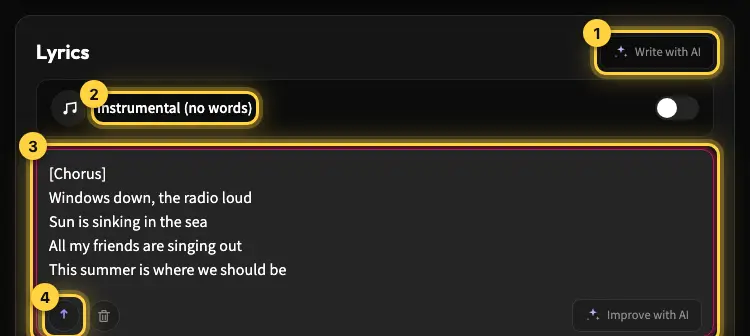
When you write your description or lyrics on the Create page, you can label the parts directly. Marking your lyrics with sections such as verse, chorus and bridge tells the model exactly where the hook should repeat and where the energy should lift.
- Use section tags in your lyrics - write clear headers like Verse, Chorus, and Bridge so the melody knows where to change and where to repeat.
- Ask for a specific form - a phrase like "verse, chorus, verse, chorus, bridge, final chorus" steers the whole arrangement.
- Describe the energy of each part - tell the AI the chorus should be bigger and the bridge should feel stripped back.
- Keep the chorus consistent - repeat the same chorus lyrics each time so the hook stays memorable rather than drifting.
- Set the mood and instrumentation - genre, tempo and vocals shape how each section actually sounds.
In practice, the tags sit on their own lines in square brackets, directly above the lines they label:
[Intro] [Verse 1] Packed the car before the sun came up Left the keys beneath the welcome mat [Chorus] This is where I start again This is where I start again [Bridge] One small road, one open sky [Final Chorus] This is where I start again
With Kleep you can let the AI write structured lyrics for you in Simple mode, or switch to Advanced mode and paste your own already divided into sections. Either way, the clearer your map, the closer the finished track lands to what you imagined. For writing the lines themselves, see our guide to writing AI song lyrics and the lyrics help article.
A practical example, start to finish
Let us build a simple pop song using the ABABCB form. Imagine an uplifting track about a fresh start. Here is how the structure comes together:
- Intro - four bars of bright piano and a soft drum pulse to set a hopeful mood.
- Verse 1 - introduce the story: someone leaving an old chapter behind, sung softly to leave room to grow.
- Chorus 1 - the hook arrives full and bright, stating the title line about starting over.
- Verse 2 - deepen the story with new details while keeping the same melody as verse one.
- Chorus 2 - the same chorus returns, now feeling familiar and earned.
- Bridge - the arrangement thins out and the perspective shifts to a single reflective line before the big finish.
- Final chorus - the chorus returns one last time, fuller than before, then a short outro fades on the main hook.
Turn that plan into a prompt like "an uplifting pop anthem about a fresh start, female vocals, bright and hopeful, structure: verse, chorus, verse, chorus, bridge, final chorus, big soaring last chorus." Generate it (each creation gives you two versions), listen for whether each section does its job, and refine the prompt until the shape feels right. On free credits, songs with lyrics run up to about 2:30, roughly 230 sung words, so keep the verses compact or use Premium for longer songs.
Put structure to work
Structure is not a rulebook that limits you, it is a set of tools that free you to focus on feeling. Once the skeleton is solid, you can experiment with melody, lyrics and production knowing the song will hold together.
The best way to learn structure is to hear it. Browse the Explore page and pay attention to where each chorus lands and how the bridge changes things. When you are ready to build your own, open the Create page, map out your sections, and press generate. If you find yourself making a lot of songs, check the pricing options for more credits and features. Want the same structure as a backing track for your own voice? See how to make an instrumental or karaoke-style track.
Frequently asked questions
What is the most common song structure in pop music?
Verse - Chorus - Verse - Chorus - Bridge - Chorus, often written ABABCB, is the form behind a very large share of hits. Verse one sets the scene, chorus one states the hook, verse two deepens the story, chorus two reinforces it, the bridge adds a twist with new chords or a new perspective, and the final chorus delivers the payoff. Simpler ABAB alternation and verse - pre-chorus - chorus are the other two forms worth memorizing.
What is the difference between a pre-chorus and a bridge?
A pre-chorus sits between a verse and a chorus and appears every time that pair repeats; its job is to raise tension so the chorus feels like a release, often by changing the chord movement or adding energy. A bridge appears only once, usually after the second chorus, and offers contrast with new chords, a new melody or a shift in perspective, so the final chorus feels bigger after a short break from it.
How do I make an AI music generator follow a specific song structure?
Tell it explicitly. Label your lyrics with clear section headers such as Verse, Chorus and Bridge so the model knows where to repeat the hook and where to lift the energy, and ask for the form by name in the prompt, for example verse, chorus, verse, chorus, bridge, final chorus. Describe the energy of each part, keep the chorus lyrics identical every time, and set genre, tempo and vocals so each section actually sounds the way you intend.
Should the chorus lyrics be the same every time?
Yes, in almost every case. Repetition is how the brain learns a melody, and a chorus that returns with the same words and tune feels familiar and earned, which is exactly why it is the part people hum the next day. Changing the chorus lyrics makes the hook drift and weakens the song's memorability. Save variation for the verses, which carry new information over a shared melody, and for the bridge.
How long should a song intro be?
Short. The intro sets the mood and pulls the listener in before the vocals, and a few bars of instruments, a single held chord or a preview of the hook is usually enough. A long intro tests the listener's patience, especially on streaming and social platforms where people skip quickly. In the worked example in this guide, four bars of bright piano and a soft drum pulse are all it takes to establish a hopeful feel.
What is AABA song form and when is it used?
AABA is an older but timeless form from jazz and the classic standards. Two A sections state the main melody, a contrasting B section acts as a single bridge, and a final A section returns to the theme. It works well for ballads, standards and songs that rely on one strong melodic idea rather than a separate chorus, and it is a good choice when you want a classic, unhurried feel instead of a pop payoff.
About the author
Kleep Editorial TeamAI music guides and product team
The Kleep editorial team builds and tests Kleep's AI song generator every day and writes practical, hands-on guides to creating songs with AI in English and Hebrew.
Create a song for the occasion
Keep reading
How Kleep Sings Hebrew: Every Layer Between Your Words and the Song
AI music tools were built for English. Every layer Kleep adds for Hebrew: grammar and gender checks, Dicta nikud, phonetic fixes and voice matching.
Creating Religious Music With AI: Niggunim, Piyyutim and Kodesh Songs in Hebrew
Create religious and Jewish music with AI in Hebrew: niggunim, piyyutim, Shabbat and holiday songs, with natural Hebrew pronunciation in minutes.
AI Song Composer: How to Write an Original Melody Without Knowing Any Notes
No need to read music to compose an original song. Use Kleep as your AI composer and turn a mood, theme or a few lines into a full melody in minutes.