
Can You Make Money With AI Music? Realistic Ways Creators Earn From Generated Songs
The short answer is yes, people do make money with AI music - but not in the way the hype suggests. Nobody is getting rich overnight by pressing generate. What actually works is treating AI music as a fast, low-cost production tool that lets you sell a service or a product people already want. This guide walks through the realistic ways creators earn, what each one pays, and how to start without quitting your day job.
First, a reality check
Before we get to the opportunities, let us be honest about the landscape. AI music lowers the cost of producing a track to almost nothing, which is powerful - but it also means the raw song itself is rarely what people pay for. The value is in what you wrap around it: personalization, speed, a specific use case, or a relationship with a customer who does not want to do it themselves.
In other words, you are not selling music. You are selling a solved problem. A couple who wants a custom wedding song, a shop owner who needs a catchy jingle by Friday, a YouTuber who needs background music that will not get flagged - these are all people with a problem and a deadline, and that is where the money lives.
The creators who earn are not the ones who make the best song. They are the ones who solve a real problem for a real person, faster and cheaper than anyone else.
Personalized song gifts as a service
This is the most accessible way to start, and often the most profitable per hour. People love giving custom songs for birthdays, weddings, anniversaries, new babies, retirements, and memorials. A personalized song with someone's name, their story, and their inside jokes is an emotional gift that a store-bought present cannot match.
The workflow is simple: you collect a few details from the buyer, write or generate lyrics that tell their story, produce the track in Kleep, and deliver a polished MP3 (MP3 download comes with Premium, or for 30 days after buying a credit pack; see credits and Premium). Because the buyer is paying for the personalization and your time, custom song gifts typically command far more than the cost of producing them. As a price anchor, Kleep's own ready-made gift song costs ILS 19.90, so a personal service with an interview, custom lyrics and revisions should sit well above that.
- Where to sell - your own social pages, local community groups, wedding and event vendors, or gift marketplaces.
- What to charge - price by occasion and turnaround, with higher tiers for rush delivery or multiple revisions.
- How to stand out - offer a short questionnaire, a fast turnaround, and one free revision so buyers feel taken care of.
Start by making a few sample gift songs for friends and family, then use those as your portfolio. Real examples sell far better than promises.
Custom jingles for local businesses
Small businesses rarely have a budget for a professional jingle, yet a memorable audio hook is exactly what they need for social ads, on-hold messages, radio spots, and in-store loops. This is an underserved market where AI music gives you a real edge on price and speed.
Think about the shops near you: a bakery, a gym, a car wash, a pizza place. Each one could use a short, catchy tune with their name in it. Each creation returns two versions, so a few creations give the owner real options in an afternoon; let them pick a favorite and deliver a clean final version. Our business jingle guide walks through the process. Because you are saving them the cost of a traditional studio, the value is obvious to them.
The trick with jingles is repeat business and referrals. A happy business owner will tell other owners, and a seasonal jingle for a holiday sale is a natural reason to come back. Focus on being reliable and easy to work with, not just cheap.
Background music for content creators
Video creators, podcasters, and streamers constantly need music that fits their content and will not trigger copyright claims. Original AI-generated tracks, which Kleep allows for commercial use on every plan, are a clean solution. You can offer custom intros, outros, transition stings, and full background beds tailored to a creator's brand and mood.
- Intro and outro themes - a short signature sound a channel uses on every video.
- Mood beds - calm, upbeat, tense, or cinematic loops for different segments.
- Podcast packages - a bundle of intro, outro, and transition cues sold together.
Content creators value consistency and turnaround. If you can become a channel's go-to person for music that always matches their vibe, you build a small recurring income instead of chasing one-off sales.
Stock libraries and royalty-free catalogs
Instead of selling to one buyer, you can build a catalog of general-purpose tracks and license them many times over. This is a slower, more passive path: you produce a library of clean, useful instrumentals - think focus music, corporate backgrounds, upbeat loops - and make them available for others to license for their projects.
Be realistic here. Stock is a volume game. A handful of tracks will earn almost nothing; a large, well-tagged, consistently useful catalog earns steadily over time. The advantage of AI production is that you can build that catalog far faster than traditional composing allows. Check each library's rules first: many stock libraries restrict or ban AI-generated music, and those that accept it usually require you to disclose it. Keep your files organized and clearly labeled.
Social content and building an audience
Some creators do not sell the music directly at all. Instead they use AI songs to grow an audience - funny songs about current events, catchy hooks tied to a niche, or themed series that people want to share. Once you have attention, you can earn through platform payouts, sponsorships, promoting your own gift or jingle service, or driving people to a catalog.
This path rewards personality and consistency over any single track. The music is the hook, but the audience is the asset. If you enjoy posting regularly and finding a specific angle, this can compound over months into something far more valuable than one-off sales.
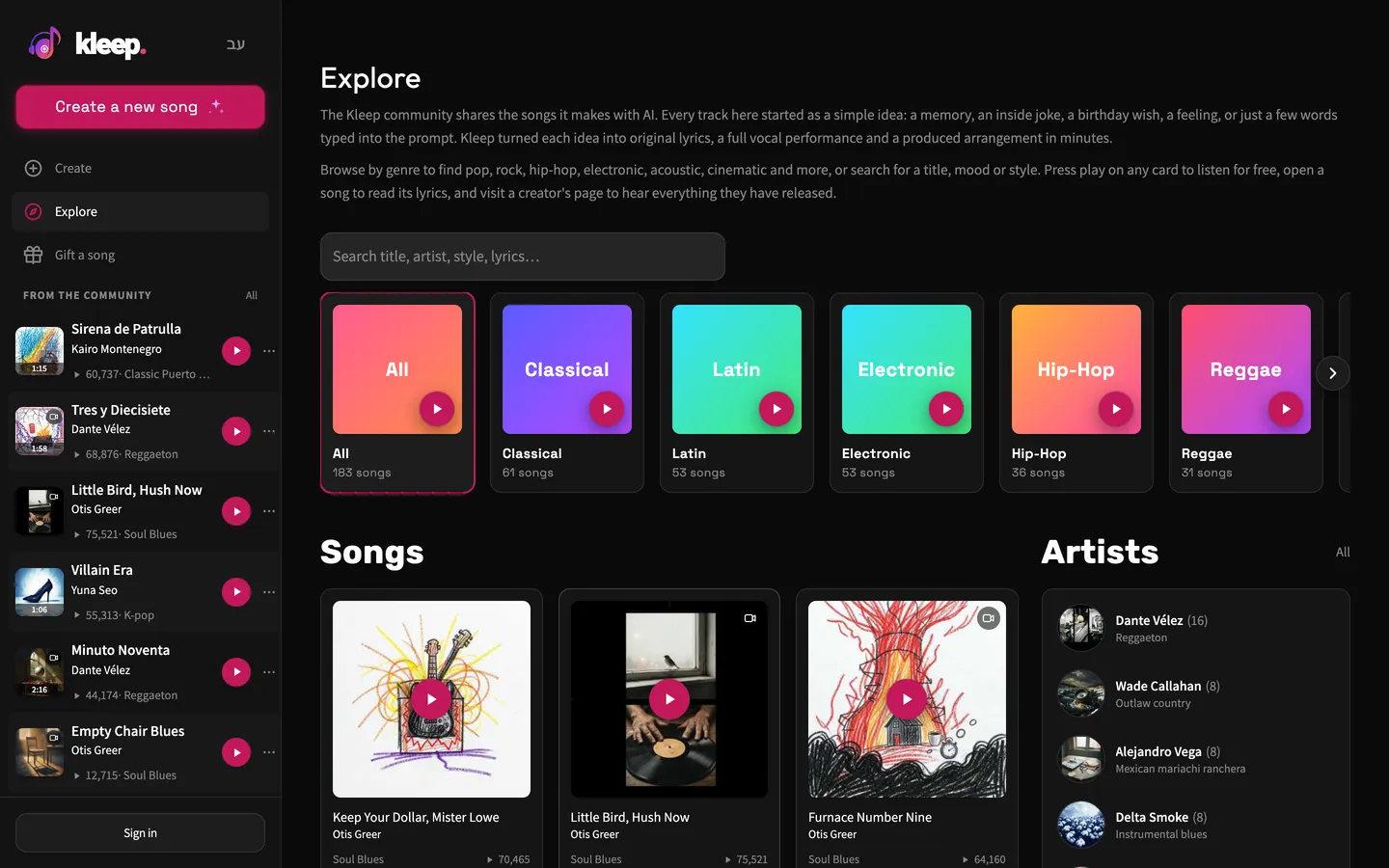
Browse the Explore page to see the kinds of themes and styles that resonate, then find an angle that is genuinely yours.
Selling on gig marketplaces
Freelance marketplaces are a straightforward place to package everything above into listed services. You can offer a custom song, a business jingle, or a content soundtrack as a fixed-price gig with clear delivery times and revision limits. The marketplace handles payment and brings the buyers; you handle production and communication.
The upside is built-in traffic and trust. The downside is competition and fees, so your reviews and turnaround matter a lot. Start with a sharp, honest listing, deliver quickly, ask satisfied buyers for a review, and raise your prices as your rating climbs.
Working with clients: rights, honesty and accounts
Selling AI music to clients is fine, but a few rules protect you and them. Kleep assigns you any rights it holds in your songs, and commercial use is allowed on every plan, including free credits. Purely AI-generated music may not be protected by copyright, and uniqueness is not guaranteed (terms).
- Do not promise exclusive copyright. You cannot transfer an exclusive copyright that may not exist. Sell the service and the delivered files, and describe the usage rights honestly instead of promising sole ownership.
- Tell clients the music is AI-made. Say up front that you produce the tracks with AI tools. It builds trust and avoids disputes later.
- Never share your account. Kleep's terms do not allow sharing your account with clients. Create the songs yourself and deliver the files or a share link.
- Check stock and marketplace rules. Many stock libraries and some marketplaces restrict or ban AI-generated music, or require you to label it. Read the rules before you upload.
For a fuller picture of what commercial use covers, read our guide to commercial use of AI music.
Earn by referring others: the Kleep affiliate program
If you already talk about AI music with your audience or clients, the most direct way to earn from Kleep itself is the affiliate program. You get 25% of every payment made by the people you refer - subscriptions, credit packs and gift songs - for life. Each commission is held for 30 days, and payouts start once your balance reaches ILS 150.
Grab your personal link on the earn page and read how invites work. It pairs well with every lane above: a client who wants to make their own songs later can sign up through your link.
Realistic expectations
Here is the honest part. Most people who try to make money with AI music earn a modest side income, not a full-time salary, at least at first. The tools are cheap and available to everyone, which means your edge is not the technology - it is your reliability, your taste, your customer service, and your ability to market yourself.
- It is a business, not a jackpot - income grows with reputation and repeat customers, not with a single viral song.
- Your time is the real cost - the song is cheap to make, but finding clients and communicating well takes real effort.
- Quality and honesty win - deliver what you promise, be clear about what AI music is, and never claim work you did not do.
- Respect the rules - always check licensing and platform terms before you sell or distribute anything.
Treat it like any small business: start small, reinvest, and let word of mouth do the heavy lifting.
A getting-started path
If you want to actually try this, here is a simple, low-risk sequence that does not require any upfront investment beyond your time.
- Pick one lane. Choose a single opportunity - gift songs, jingles, or content music - and ignore the rest for now.
- Build three samples. Make three strong examples in Kleep so you have a portfolio to show.
- Make your first offer. Tell friends, family, and a few local businesses what you do, with a clear price and turnaround.
- Deliver and collect feedback. Do your first few jobs, even at a low price, and ask for honest reviews.
- Raise prices and repeat. As your samples and reviews grow, charge more and lean into what is working.
Each creation costs 5 credits and returns two versions; the 10 free credits at sign-up cover your first two samples, and Premium refills your balance to 150 credits each month, which is 30 creations. When you start creating regularly, check the pricing options to unlock the credits and features you need to keep up with demand. The path to earning is not a secret trick - it is one real customer, served well, repeated. Open the Create page and make your first sample today.
Frequently asked questions
What actually sells when you make money with AI music: the song or something else?
Something else. AI drops the cost of producing a track to almost nothing, so the raw song is rarely what people pay for. They pay for a solved problem wrapped around it: personalization, speed, a specific use case, or simply not having to do it themselves. A couple who wants a custom wedding song or a shop owner who needs a jingle by Friday is buying the outcome and the deadline, not the audio file.
How much can I charge for a personalized AI song gift?
Far more than it costs to produce, because the buyer is paying for the story, the person's name and inside jokes, and your time rather than the generation itself. Price by occasion and turnaround, with higher tiers for rush delivery or extra revisions. Kleep's own ready-made gift song costs ILS 19.90, a useful floor for a personal service. A short questionnaire, a fast turnaround and one free revision make buyers feel looked after, and a few sample songs made for friends and family work as your first portfolio.
How do I sell AI jingles to local businesses?
Start with the shops near you: a bakery, a gym, a car wash, a pizza place. Most have no budget for a studio jingle but could use a short, catchy tune with their name in it for social ads, on-hold messages or in-store loops. Produce a handful of options in an afternoon, let the owner pick one, and deliver a clean final. Reliability earns referrals, and a seasonal jingle for a holiday sale brings the client back.
Is building a stock music library with AI worth it?
It is a slow, volume-driven path, so be realistic. A handful of tracks earns almost nothing; a large, well-tagged, consistently useful catalog of focus music, corporate beds and upbeat loops earns steadily over time. AI lets you build that catalog much faster than traditional composing, which is the real advantage. Check each library's AI policy first, since many restrict or ban AI-generated music, and keep every file organized and clearly labeled.
How much money do people realistically make with AI music?
Most earn a modest side income rather than a full-time salary, at least at first. The tools are cheap and available to everyone, so the technology is not your edge; reliability, taste, customer service and marketing are. Income grows with reputation and repeat customers, not a single viral song, and the time you spend finding clients and communicating is the real cost. Treat it like any small business: start small, reinvest, and let word of mouth compound.
What is the fastest way to get a first paying customer for AI music?
Pick one lane, gift songs, jingles or content music, and ignore the rest. Build three strong samples so you have something to show. Tell friends, family and a few local businesses what you offer, with a clear price and turnaround. Do the first jobs even at a low price, ask for honest reviews, then raise prices as your samples and ratings grow. Gig marketplaces work too, but reviews and speed decide everything there.
Can I sell a client the exclusive copyright to an AI song?
No. Purely AI-generated music may not be protected by copyright, so you cannot transfer an exclusive copyright that may not exist. Kleep assigns you any rights it holds and allows commercial use on every plan, and you can pass the delivered files on to a client for their use. Tell the client the music is AI-made, describe the rights honestly, and never share your Kleep account with them.
Does Kleep have an affiliate program?
Yes. You earn 25% of every payment made by people you refer, including subscriptions, credit packs and gift songs, for life. Commissions are held for 30 days and paid out once your balance reaches ILS 150. Get your link on the earn page.
About the author
Kleep Editorial TeamAI music guides and product team
The Kleep editorial team builds and tests Kleep's AI song generator every day and writes practical, hands-on guides to creating songs with AI in English and Hebrew.
Keep reading
Free AI Music for Commercial Use: Where to Get It and What You Can Do With It
Is free AI music safe for your business videos, ads and content? This guide explains commercial use plainly and shows how to make original tracks with Kleep.
How to Create Music for a Commercial Without Paying for a Studio
Produce social and web ad music with AI: match your brand and ad length, use it commercially, and skip the studio. A practical step-by-step guide.
Music for a Corporate Promo Video: How to Choose and Create a Custom Soundtrack
Score your company profile video: match music to your brand values, sync it to scenes and narration, skip generic stock music, and use it commercially.