
Music Prompt Writing Guide: How to Make AI Understand Exactly the Style You Want
If you have already created a few tracks in Kleep, you know the strange gap between the song in your head and the song that comes out of the speakers. The AI is not reading your mind - it is reading your words. A vague prompt gives you a vague, generic result, while a precise, well-structured prompt gets you surprisingly close on the first try. This guide is written for people who are past the beginner stage and want to become genuinely good at directing AI music. We will break a prompt into its working parts, show real examples you can copy, and give you a repeatable method for turning a fuzzy idea into a sharp instruction.
Think in five layers, not one sentence
The single biggest upgrade you can make is to stop writing one flat sentence and start thinking in layers. Almost every great music prompt is really a stack of five decisions, and when even one layer is missing the model fills the gap with its own average guess. The five layers are genre, mood, instrumentation, tempo, and vocals.
- Genre - the overall style bucket: indie folk, synthwave, boom-bap hip hop, orchestral cinematic, lo-fi bedroom pop.
- Mood - the emotional temperature: hopeful, melancholic, triumphant, tense, playful, nostalgic.
- Instrumentation - the specific instruments you want front and center: fingerpicked acoustic guitar, warm analog synth, brushed drums, string section, 808 bass.
- Tempo and energy - slow and spacious, mid-tempo groove, driving and fast, roughly in BPM if you know it.
- Vocals - who is singing and how: soft female vocal, gritty male voice, layered harmonies, spoken word, or fully instrumental.
When you name all five, the model has almost nothing left to guess. When you name only the genre, it guesses the other four, and that is exactly where results drift away from what you imagined.
From vague to precise: a before and after
Here is a prompt most people write on their first attempt. It is not wrong, it is just underspecified, so the output could go in a hundred directions.
A sad piano song about missing someone.
Now watch what happens when we apply the five layers. Same idea, but every layer is filled in with intention.
Slow, intimate indie ballad, around 68 BPM. Melancholic and tender mood. Sparse fingerpicked acoustic guitar and a soft felt piano, light room reverb, subtle cello swells in the chorus. Breathy female vocal, close-mic, with delicate harmonies on the hook. About the ache of missing someone who has moved on.
The second prompt is not longer for the sake of length - every extra word removes a decision the model would otherwise make randomly. That is the whole game.
Use reference-style language, not adjectives alone
Adjectives like nice, cool, or epic mean almost nothing to a music model because they are not tied to sound. Instead, describe the sonic character in terms the model can map to real production choices. Compare vague words to concrete ones:
- Instead of epic, say wide cinematic strings, big taiko drums, and a soaring choir in the final chorus.
- Instead of chill, say downtempo lo-fi beat, dusty vinyl crackle, mellow Rhodes piano, and a lazy swung groove.
- Instead of energetic, say four-on-the-floor kick, bright plucky synth, hand claps, and a rising build into a drop.
- Instead of retro, say 1980s gated reverb snare, analog synth bass, and shimmering chorus-drenched guitars.
You do not need to be a producer to do this. You only need to name the textures and instruments you can already hear, and let Kleep translate them into an arrangement.
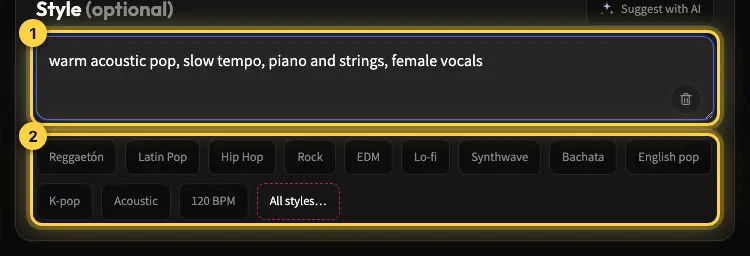
One rule: describe the sound, never a real artist. Writing an artist or band name in Style ("sounds like ...") blocks the generation. Translate the reference into genre, era, instruments and vocal texture instead, for example "early 2000s Mizrahi pop, oud and darbuka, emotional male vocal".
A repeatable method for building any prompt
When you are staring at a blank box, follow this order every time. It turns a fuzzy feeling into a finished instruction in about a minute.
- Name the genre in two or three words so the model knows the world you are in.
- Add one or two mood words that capture the emotional core.
- List the two or three instruments you most want to hear, and mention what they should do (lead, pad, groove).
- Set the tempo and energy - a rough BPM or a phrase like slow and spacious.
- Describe the vocal - gender, texture, harmonies, or state clearly that it is instrumental. There is no separate voice picker, so this line is how you choose the singer; leave it out and the gender is matched to the lyrics.
- Finish with a short line about the subject or scene so the lyrics and feel line up.
Run through those six steps and you will almost never produce a lazy prompt again. Save the ones that work - your personal library of proven prompts is the fastest path to a signature sound. The styles and voices guide shows where each layer goes on the Create page.
Genre-specific example prompts you can copy
Here are three complete prompts across very different styles. Notice how each one still hits all five layers even though the vocabulary changes completely.
Uptempo synthwave, around 118 BPM. Nostalgic yet driving mood. Pulsing analog synth bass, bright arpeggiated leads, gated reverb snare, and shimmering pads. No lead vocal - fully instrumental, with a soaring synth melody carrying the chorus. A late-night drive under neon lights.
Warm acoustic folk, mid-tempo around 92 BPM. Hopeful and grounded mood. Fingerpicked acoustic guitar, upright bass, brushed drums, and a touch of mandolin in the bridge. Warm male vocal, natural and unpolished, with a small group singing the final chorus together. About starting over in a new town.
Modern R&B ballad, slow at 72 BPM. Sensual and confident mood. Deep sub bass, muted electric piano, crisp finger snaps, and airy background pads. Smooth female vocal with rich stacked harmonies and a few improvised runs at the end. About choosing yourself first.
Try one of these as-is in the create page, then change a single layer - swap the tempo, the vocal gender, or one instrument - and listen to how surgically the result shifts. That controlled experimentation is how you build real intuition.
Iterate like a producer, not a gambler
The biggest mistake experienced users still make is re-rolling the same prompt over and over hoping for luck. A better approach is to treat every generation as feedback and change exactly one thing at a time.
If the vocal is too polished, change only the vocal line to gritty and raw. If the drop is weak, change only the tempo and energy words. One variable per attempt tells you what actually did the work.
This is how you go from getting lucky occasionally to getting the result you wanted reliably. It is also how a community of serious creators talks to each other - by sharing precise, layered prompts instead of vague wishes. Browse the explore page to hear what specific choices sound like in finished tracks, see how to choose a genre and style and how to make your AI songs sound more professional, and then open the create page and put the five-layer method to work on your next song.
Frequently asked questions
What should a music prompt for an AI song generator include?
A strong prompt covers five layers: the genre (indie folk, synthwave, boom-bap), the mood (melancholic, triumphant, playful), two or three specific instruments and what they do, the tempo or energy with a rough BPM if you know it, and the vocal - gender, texture, harmonies, or a clear note that the track is instrumental. Finish with one line about the subject or scene so the lyrics match the feel. Leave a layer out and the model fills it with an average guess.
Why does my AI music sound generic even though I described the genre?
Naming only the genre leaves four other decisions to the model: mood, instrumentation, tempo and vocals. It fills each one with the most statistically average choice for that genre, which is exactly what generic sounds like. The fix is not a longer prompt for its own sake but a more complete one. Add the mood, the two or three instruments you want up front, the energy level and the type of voice, and the output stops drifting toward the middle.
Should I include a BPM in my music prompt?
Yes, when you have a number in mind, because tempo is one of the five layers that most shapes the feel of a track. A rough figure is enough: around 68 BPM for a slow, intimate ballad, 92 for a mid-tempo acoustic groove, 118 for an uptempo synthwave drive. If you do not think in BPM, use a clear phrase instead, such as slow and spacious, mid-tempo groove, or driving and fast. Either way, say something rather than leaving it to chance.
How do I describe the sound I want without knowing music production terms?
Replace loose adjectives with the textures and instruments you can already hear. Instead of epic, ask for wide cinematic strings, big taiko drums and a soaring choir in the final chorus. Instead of chill, ask for a downtempo lo-fi beat with vinyl crackle and a mellow Rhodes piano. Instead of retro, name a 1980s gated reverb snare and analog synth bass. You are not producing the track, you are pointing at sounds, and the generator translates them into an arrangement.
How do I fix an AI song that is close but not quite right?
Change one variable per attempt instead of re-rolling the same prompt hoping for luck. If the vocal is too polished, edit only the vocal line to gritty and raw. If the drop feels weak, edit only the tempo and energy words. If an instrument is wrong, swap that one instrument. Each generation then tells you exactly what did the work, and you move from occasional lucky results to reliably getting the sound you asked for.
How do I ask for an instrumental track with no vocals in the prompt?
State it explicitly in the vocal layer rather than leaving it blank, for example: no lead vocal, fully instrumental, with a soaring synth melody carrying the chorus. Naming what takes the place of the singer matters, because otherwise the model may add vocals anyway or leave the chorus feeling empty. The synthwave example in this guide does exactly that, handing the lead melody to an instrument so the structure still peaks where a chorus would.
About the author
Kleep Editorial TeamAI music guides and product team
The Kleep editorial team builds and tests Kleep's AI song generator every day and writes practical, hands-on guides to creating songs with AI in English and Hebrew.
Keep reading
How Kleep Sings Hebrew: Every Layer Between Your Words and the Song
AI music tools were built for English. Every layer Kleep adds for Hebrew: grammar and gender checks, Dicta nikud, phonetic fixes and voice matching.
Creating Religious Music With AI: Niggunim, Piyyutim and Kodesh Songs in Hebrew
Create religious and Jewish music with AI in Hebrew: niggunim, piyyutim, Shabbat and holiday songs, with natural Hebrew pronunciation in minutes.
AI Song Composer: How to Write an Original Melody Without Knowing Any Notes
No need to read music to compose an original song. Use Kleep as your AI composer and turn a mood, theme or a few lines into a full melody in minutes.